In This Article
A check printed in Bogotá and a check printed in Quito can look identical to the human eye and still be unreadable to each other’s banks. The reason has nothing to do with paper, security features, or the toner in the cartridge. It is the MICR standard the code line is encoded in.
There are two of them in commercial use worldwide — E-13B and CMC-7 — and they are not interchangeable. Across the seven markets we supply — the United States, Panama, Ecuador, Colombia, Honduras, El Salvador and the Dominican Republic — both standards are in service, and neighbouring countries do not always share one. If you print checks, encode code lines, or supply financial printers, this is the distinction that decides whether an item clears automatically or lands in a manual exception queue.
Two standards, one job
Both standards do the same thing: they print the account, routing and serial data along the bottom of a check in magnetic ink, so that sorting equipment can read it mechanically rather than optically. What separates them is the character set and the way a reader interprets the magnetic signal.
If you are new to the underlying technology, our explainer on what MICR is and how it works covers the fundamentals first.
E-13B: the Anglo-American standard
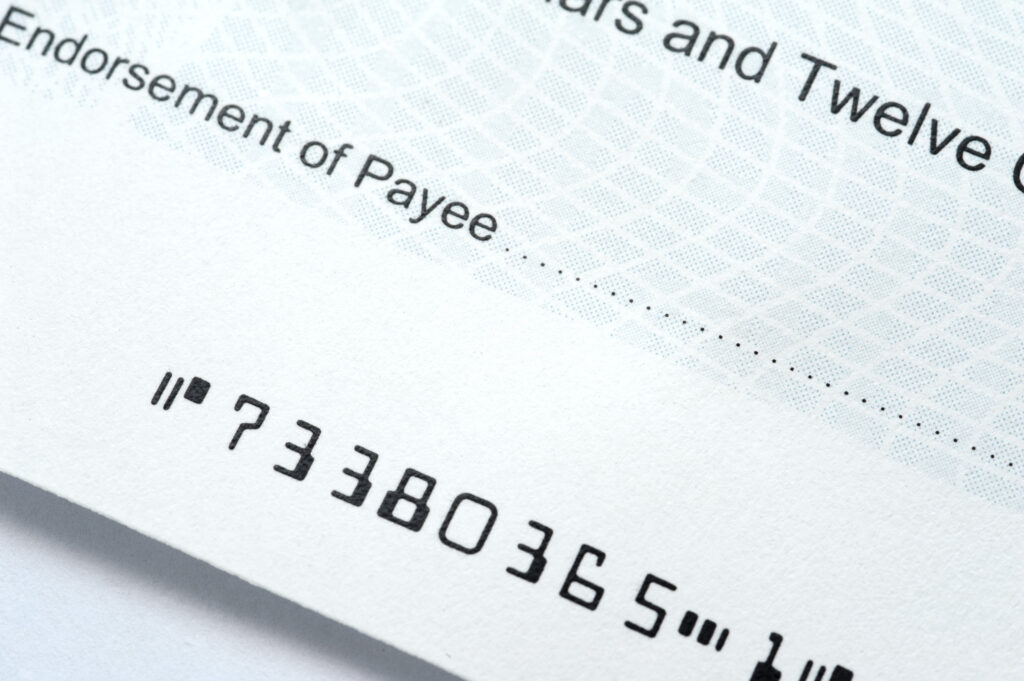
E-13B carries 14 characters — the ten digits plus four control symbols: transit, amount, on-us and dash. The name is prosaic: font “E”, the thirteenth design iteration, revision B.
Its distinguishing feature is how it is read. Each character is drawn so that, as it passes the magnetic read head, it produces a unique waveform. The reader is not recognising a shape; it is recognising a signal. That is why E-13B characters look slightly odd to the eye, with their thickened blocks and notches — the geometry exists to shape the waveform, not to please a designer.
E-13B is the standard in the United States, Canada, the United Kingdom, Australia, Japan and India. In our region, it is used in Colombia and Panama.
CMC-7: the European and South American standard
CMC-7 was developed in France by Bull, and its name describes its construction: caractères magnétiques codés at seven bars. Every character is built from seven vertical bars separated by six gaps, and the pattern of wide and narrow gaps is what encodes the value. The reader measures spacing rather than waveform shape.
CMC-7 carries 15 characters — the ten digits plus five control symbols, one more than E-13B.
It is the standard across France, Spain, Italy, Brazil, Israel and much of the Mediterranean, and it is widely used through South America.
The seven markets we supply
We ship MICR toner, ribbons, verifiers and check scanners into seven markets. Here is where each one stands, and where you should verify before committing to a print line:
| Market | Standard | What to know |
|---|---|---|
| United States | E-13B | Governed by the ANSI X9.100 series. Magnetic ink remains mandatory for the code line. |
| Panama | E-13B | A dollarised economy with check formats closely aligned to United States practice. |
| Colombia | E-13B | The notable exception in South America, where CMC-7 otherwise predominates. |
| Ecuador | CMC-7 | In line with the wider South American pattern. |
| Honduras | Confirm locally | Central American practice is mixed. Verify with the clearing house or receiving bank. |
| El Salvador | Confirm locally | Dollarised, but that does not by itself determine the code-line standard. Verify before printing. |
| Dominican Republic | Confirm locally | Caribbean practice varies. Request the code-line specification from the receiving institution. |
Where this table says confirm locally, we mean it literally: published sources disagree, and we would rather you obtain the specification from the clearing house than take a guess from a supplier’s blog. If you tell us the market, we will help you track it down.
What happens when the standard is wrong

A reader configured for one standard will not interpret the other. The code line is not misread — it is simply not read. In practice that means the item drops out of automated processing and into manual data entry, which introduces delay, cost and keying errors, and can result in items being returned.
It is worth noting that image-based clearing has not removed this requirement. The Accredited Standards Committee X9 advisory states plainly that magnetic ink is still required for machine-readable code lines, and that data printed without it “cannot be magnetically captured and may require manual data entry.” Optical capture is a complement to magnetic reading, not a replacement for it.
The point that catches people out: the toner is not the font
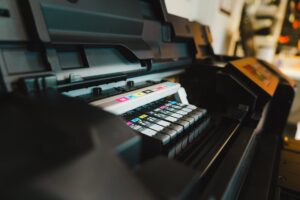
This is the single most common source of confusion we encounter, so it is worth stating directly.
MICR toner is magnetic regardless of which standard you print. The iron-oxide formulation that makes the code line machine-readable is the same requirement for E-13B and for CMC-7. There is no “CMC-7 toner” and no “E-13B toner.”
The font is a separate matter entirely. It lives in the printer — on a font card or DIMM — or in the print driver, or in the check-printing software generating the document. Which means the two decisions are independent:
- Buying genuine MICR toner ensures the code line is magnetic.
- Having the correct font installed ensures the code line is in the right standard.
Get the first right and the second wrong, and you produce a beautifully magnetic code line that the receiving bank’s equipment cannot interpret. Both have to be correct.
How to confirm which standard you need
Do not infer it from the map. Latin America is genuinely mixed, and neighbouring countries do not necessarily share a standard. Confirm it from a source that carries authority in the market you are printing for:
- The central bank or clearing house specification. This is the definitive answer and it is usually published.
- The receiving bank’s code-line specification. Banks will supply the required format, dimensions and tolerances on request.
- An existing cleared check from that market. The two fonts are visually distinct once you know what you are looking at — E-13B characters are blocky and irregular, CMC-7 characters are built from visible vertical bars.
- The printer’s installed font. Confirm what is actually loaded rather than what was ordered.
Before you order supplies
A short checklist that prevents most of the problems we see:
- Which standard does the destination market require — confirmed, not assumed?
- Which printer model, and is the correct font resident on it?
- Does the equipment take toner cartridges or MICR ribbons?
- Is there a verifier in the workflow to check magnetic signal strength before checks leave the building?
You can see the full range of MICR toner cartridges, ribbons, verifiers and check scanners on our products page, and our frequently asked questions cover ordering, compatibility and shipping across the region.
Frequently asked questions
Is MICR toner different for E-13B and CMC-7?
No. Magnetic toner is the same requirement for both standards. The difference between them is the font, which resides in the printer, the driver or the check-printing software — not in the cartridge.
Can one printer produce both standards?
Yes, provided both fonts are available to it. Many financial printers serving multiple countries keep both resident so a single device can handle work for different markets.
Which standard does Latin America use?
Both, depending on the country. Colombia and Panama use E-13B, while CMC-7 is widespread through South America. Because it is mixed, confirm the requirement with the clearing house or receiving bank for each market rather than assuming regional consistency.
What happens if a check is printed in the wrong font?
The reader will not interpret the code line at all. The item falls out of automated processing into manual entry, causing delays and additional cost, and may be returned.
Does image-based clearing mean magnetic ink is no longer needed?
No. Standards bodies have been explicit that magnetic ink remains required for machine-readable code lines. Image capture works alongside magnetic reading rather than replacing it.
Do we need a MICR verifier?
We recommend one in any production check-printing workflow. A verifier confirms the signal strength and character quality of the printed code line before the checks leave your facility, which is considerably cheaper than discovering a problem after a bank rejects a batch.
Getting the specification right the first time
Tinta Industries supplies MICR toner cartridges, ribbons, verifiers and check scanners to financial printers and institutions across the United States, Panama, Ecuador, Colombia, Honduras, El Salvador and the Dominican Republic. If you are setting up a new print line, entering a new market, or are unsure which standard a client’s checks require, contact us and we will help you confirm the specification before you commit to equipment or supplies.